
Customers’ choices
What makes customers choose your brand?
Ask customers what they need, what they compare and why they choose you or an alternative. Understand how they perceive your products’ value and what makes them hesitate.
Popscale for brands & manufacturers
Understand what customers ask for and what retailers need to succeed. Capture their experiences with AI interviews. Let salespeople practice customer conversations about your products, with feedback based on your range and methods.

For brands that sell through retailers. From consumer electronics and appliances to building products and other specialist products.
Your products share shelf space with many others. Let retailers’ salespeople practice what a product sheet cannot: understanding the need and explaining the difference that matters.
The product knowledge and value you want to convey.
The questions and recommendation in the store.
Understanding what the product can do in everyday life.
Studies · The perspectives behind the recommendation
The product sheet shows what you want to communicate. Customers and retailers can tell you how it comes across. Let AI interview them about your products, customers’ questions and support in stores. A few well-chosen questions can be enough to find something to improve.
Customers’ choices
Ask customers what they need, what they compare and why they choose you or an alternative. Understand how they perceive your products’ value and what makes them hesitate.
The retailer’s perspective
Capture the questions that are hard to answer, differences that are hard to demonstrate and material or demonstrations salespeople are missing. Gather their ideas and approaches that work.
Product launches
Listen to reactions after a launch. What do customers understand straight away? What needs a clearer explanation? Separate questions about the product from those about price, information and availability.
Field sales and product support
Ask retailers and product trainers how cooperation works. Find out what happens to questions from the shop floor and what would make it easier to get the right help.
Fictional example · A new vacuum cleaner
A brand wants to understand how its new vacuum is presented. Salespeople’s experiences offer a starting point for a closer look.
Three questions for retailers’ salespeople
Retailer’s salesperson
“The material covers power settings and attachments. But the customer I spoke to wanted to carry the vacuum upstairs. We compared the weight and grip, and that made the difference clear.”
A possible explanation to follow up
This experience points to a possible gap in product support. Ask more salespeople and customers what helps them compare before drawing a broader conclusion.
A possible next step
Try a simple demonstration of lifting, holding and emptying the vacuum with one retailer. Find out what customers understand better and what salespeople need before changing the material for more stores.
From product features to customer value
Let salespeople practice answering customers’ questions, using your range as the starting point. The goal is a relevant recommendation, not the longest list of features.
Appliances
“Why should I pay more for this one?”
Find out how the customer uses the product. Explain which differences matter in their daily life, and when the simpler model is enough.
Consumer electronics
“What’s actually different about these models?”
Translate technical differences into things the customer will notice. Start with how they will use it before going through specifications.
Building products and tools
“Do I really need that feature?”
Explore the project, how often the tool will be used and what the customer already owns. Show what the feature helps with without overstating its value.
Across brands
“I usually buy another brand.”
Understand what the customer appreciates about their current choice. Show a relevant alternative without dismissing a competitor or pushing for a switch.
“We already stock a similar range. Why should we give shelf space to your products as well?”
Your turn. What would you say?
“There’s a cheaper version right next to it. What should I say when a customer asks why yours costs more?”
Your turn. What would you say?
“Last time, the promotion sold out straight away. How can we feel confident about backing this launch?”
Your turn. What would you say?
“We keep getting new material, but store teams still don’t know who the product suits. What do we need to change?”
Your turn. What would you say?
This is how a roleplay could begin. In Journeys, you respond by speaking and get feedback based on your facts, methods and procedures.
Journeys in practice
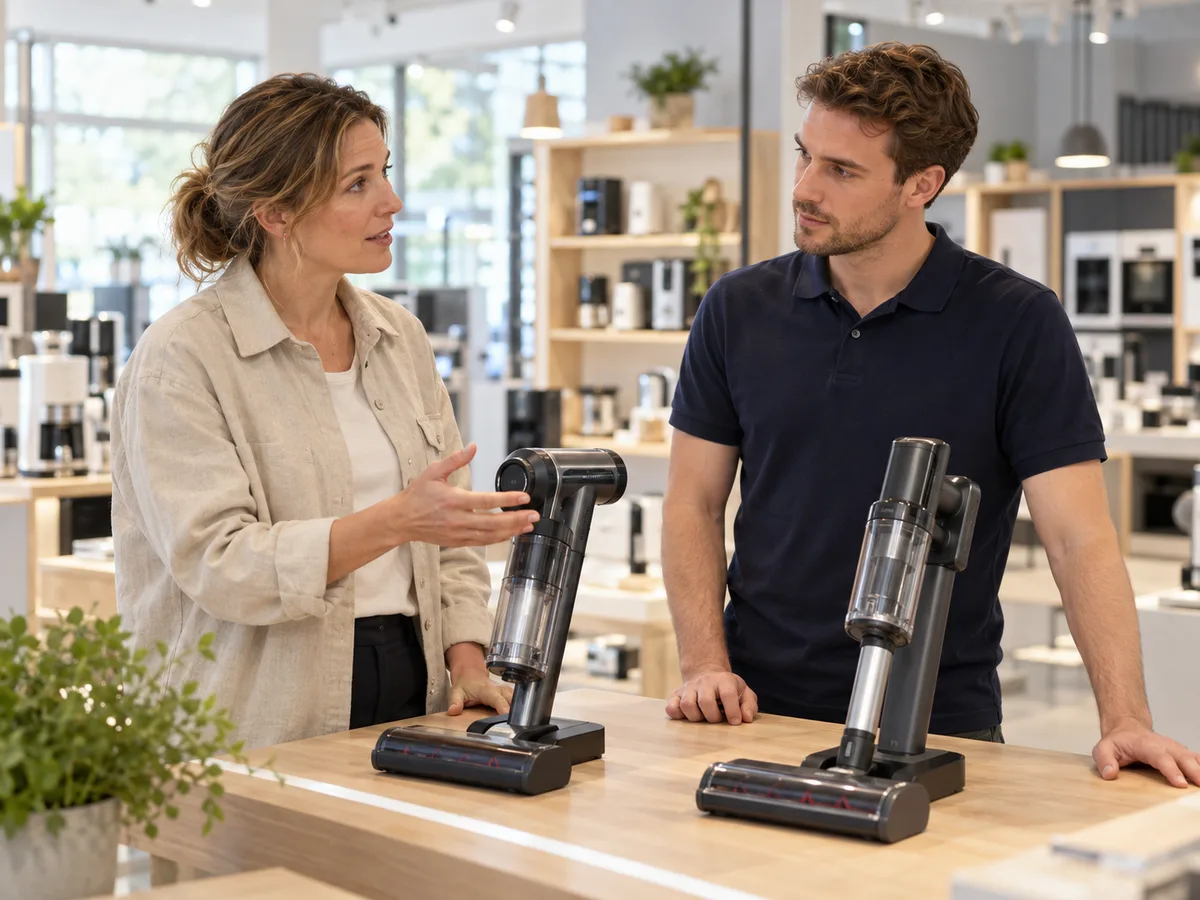
The customer compares two vacuum cleaners. See how the salesperson moves from listing features to exploring how the product will be used.
From a fictional practice conversation
Exercises draw on your reviewed product material, customer questions and ways of working. The AI customer can compare models, question the value and ask follow-up questions. Feedback assesses how the salesperson uses your product knowledge to understand the need and make a relevant recommendation.

Speaking
Before your next product launch
Give retailers’ salespeople the chance to learn about the new product and practice customer questions before launch. The same approach works for salespeople who are new to your range.

Episodes & Flashcards
Explore use cases, important differences and limitations. Review what the salesperson needs to know using your reviewed product material.
Coaching & Roleplay
Explain the value in your own words and meet different AI customers. Get feedback on needs discovery, the explanation and how you move the conversation forward.
Assessments
Assess knowledge and conversations against your criteria. Use the results to decide what the salesperson needs to review or practice further.
Use activities independently or bring them together in a Journey. You choose the content, participants and approach.
Explore training before launchFor field salespeople and product trainers
Knowing the product is one thing. Helping someone else sell it is another. Practice feedback that encourages the salesperson to try a new approach in their next customer conversation.
Example · from specifications to needs
A store salesperson knows the product’s features but always starts with specifications. How do you help them first discover what the customer needs help with?
An opening to try
“You explained the differences clearly. What did you find out about how the customer would use the product?”
Listen to the salesperson’s perspective and practice a needs question together. Agree on what they will try before your next check-in.
Follow salespeople’s practice and listen to questions from the store floor.
Insights · training
Follow participation, attempts and exercise results for the participants you are authorized to follow. Track sales to end customers separately in your own or your retailers’ sales data.
Explore InsightsStudies · the retailer’s perspective
“Which customer questions are hardest to answer about the new product?”
Use AI-led Interviews in Studies to capture difficult questions and how experienced salespeople make the product’s value clear. Review their experiences in the study’s own report and use them to inform clearer product information, shared ways of working and training.
Explore StudiesCommon questions
The starting point is your brand and products, while participants work for retailers. Training helps them understand the range, connect features to customer needs and make relevant recommendations. Field salespeople and product trainers can also practice their coaching.
Yes. Build activities around your reviewed product material, common customer questions and clear assessment criteria. Practice both when the product is suitable and when another solution is more relevant.
Participants need membership and the right permissions in the company account where the training is hosted. Content can be made available through departments or by assigning participants to a Journey. The setup and responsibility for access need to be agreed before you start. Content is not automatically shared between separate company accounts.
No. Salespeople practice with fictional AI customers. Exercises do not require recordings or personal information from your real customers.
Authorized managers and administrators can read participants’ transcripts and feedback. Conversations are not private between the participant and the AI. Decide who should have access and explain the setup to participants.
Yes. Start with one product group and a few important customer questions. Activities can be used independently or brought together in a Journey. Follow training in Popscale and evaluate sales separately in your business systems.
Yes. Use Studies to ask a few questions about your products, customers’ reactions or support in stores. AI interviews follow up on answers and gather experiences in the study’s own report. You do not need to start with a large project or combine the study with training.
No. Use Studies to understand a question and Journeys when salespeople need to practice something. A study can also inform clearer product information, better demonstrations or different support. You choose the next step; a study does not automatically create a Journey.
A first conversation
Tell us about your products, retailers and questions from the shop floor. We’ll discuss what you want to understand with Studies or which conversations you want to practice, and show a relevant example.